
Part 2 Charles James Campbell: Ships & Pork-barrels

Updated: Jul 26
This is part 2 in a series on the life of Baddeck politician and businessman Charles J Campbell. You can read more about his life here:
Ships & Pork-barrels
Ottawa - April 17, 1878
CJ Campbell exploded from his seat on the floor of the House of Commons.
After almost 24 hours of steady debate, and far too many drinks, his Scottish warrior blood was boiling.

Campbell – then 59, stumbled his way from the back bench, through the crowded rows of official opposition parliamentarians, seated two to a desk and past the leader of the party Sir John A. McDonald and his top lieutenant Charles Tupper, both fathers of Confederation, both with front row seats, and lurched into the centre aisle and turned toward his target.
Adjusting his top hat - as one must maintain a sense of decorum in the hallowed halls of Parliament - he faced Speaker of the House Timothy Warren Anglin, swung his walking stick around his head as though it was a sword, and dared Anglin or anyone – ANYONE! - to come at him. Then Campbell took aim at Prime Minister Alexander Mackenzie, seated across the aisle from Sir John A. MacDonald’s Tories, and lunged toward McKenzie and cursing loudly, before the Sergeant-at-Arms was able to finally reach Campbell and haul him out of the House of Commons.
Politicians Row: In April 1878, Sir John A., CJ Campbell and other MP's got drunk during a 28-hour filibuster in the House of Commons. (L-R) Sir John A. McDonald was the leader of the Opposition, Charles Tupper was his top Lieutenant in Parliament - both were Fathers of Confederation; Timothy Warren Anglin was the Speaker of the House and Alexander McKenzie was the Prime Minister. (Photos: Parliament of Canada)
Headlines from across the country in April 1878.
THE HONOURABLE CJ CAMPBELL
Charles James Campbell was known variously as Charles, Charlie, and CJ. Following his entry into politics, the prefix ‘The Honorable’ appears as part of his name, the result of an appointment to the Executive Council of Nova Scotia, a governmental cabinet, in 1857.
He was a successful businessman: opening stores in new settlements, establishing a shipbuilding industry in Baddeck and amassing land holdings throughout Victoria County. He ran in 16 elections. The six contests he won were under a cloud of corrupt irregularities; three were eventually overturned. He used his influence to install his family and friends as sheriffs, returning officers and poll clerks and exploited close election contests to sow confusion, claiming some votes cast for his opponent were illegal.
Throughout his life, he was determined and ambitious; arrogant and manipulative. He had an inflated sense of importance and entitlement. He could be ruthless, boastful, and hostile, but also kind-hearted, helpful and benevolent.
While still in the earliest days of his first business venture, Charles, then 28, regularly sent money to his unmarried sisters still living in Scotland; he paid tuition at the University of Edinburgh so his youngest brother Lachlin could earn his Divinity degree. When his oldest brother Colin moved to Tasmania and encountered financial problems, Charles sent his own ship, the schooner Native Lass, laden with goods for Colin to sell.
BADDECK
The first we hear of Charlie in Baddeck is from Robert Elmsley in 1840. He notes it is Charlie who is behind the counter at William Kidston’s store on the island when Elmsley first arrives in Baddeck.

Within a year, Charlie has left Kidston and instead leased land from him on the mainland of Baddeck, at the eastern point of Water Street. There he built his own store, Campbell & Company and competed directly with Kidston.
In conducting business with his mostly Highland Scots customers, Campbell spoke Gaelic, his mother tongue, as he sold them ‘muslin dresses and coloured cashmere, cotton handkerchiefs and gloves of all sizes’ as one 1852 newspaper ad stated. Customers at his mercantile could also load up on tea, leather, molasses, stationary, books, soap, candles, corn meal, flour, rum, gin and brandy, all ‘sold cheap for cash or country produce’.
Early in January 1843, Charles married 23-year-old Eliza Jane Ingraham, daughter of area Sherrif Jacob Styles Ingraham – a well-connected Baddeck resident with ties to the Margarees. Eliza’s sisters married other early influential Baddeckers and so Charles was brother-in-law to the Postmaster Robert Elmsley and merchants Charles and Joseph Hart.
On November 27, 1843, the first of their 10 children was born. Son Colin Nicol was named for Charles’ older brother, who had mentored him during his early days on Cape Breton Island, helping him navigate life in Richmond County, with a violent, alcoholic step-father.
Top: Eliza Jane (Ingraham) and husband Charles J Campbell dressed in Campbell tartan. (Campbell family) Below: Duntulum Cottage, built by Campbell in 1844. Named for a castle near his birthplace in the Scottish Highlands, the building was lost to fire in the 1960s. It overlooked his shipyard, the Old Post Office and was located where MacLeod House is today .
Within a year, Campbell constructed a home suitable for a Scottish laird. Located on a steep rise, overlooking the blue waters of Baddeck Harbour, he named it Duntulum Cottage, after a castle near his birthplace in the Scottish Highlands. It was a grand, two-story house, with an impressive staircase and covered deck at the front, and large windows with a stunning view that overlooked his growing empire.
To the west, on the new main street of Baddeck, his relocated store, Campbell & Company; to the north, his Duntulum warehouse and below him, at the waters edge, his shipyard (the current location of the Bras d’Or Yacht Club).
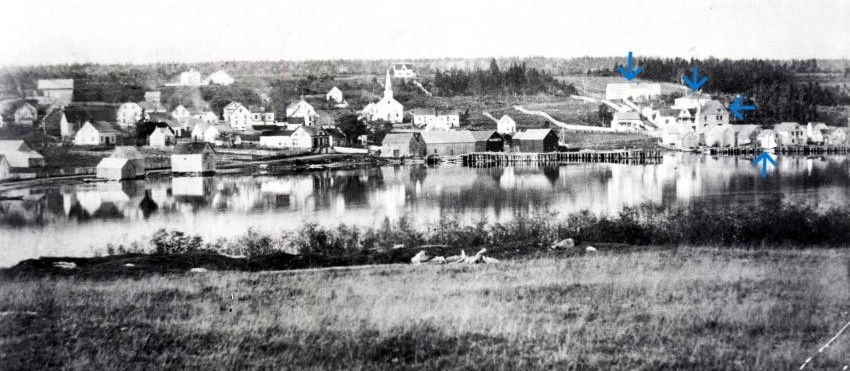
When Campbell was 25, he oversaw the construction of his first ship the Highlander, a 54-ton brig, launched in 1842, it's main mast chosen by Campbell from his own lands, near the present-day MacLeod House. The Highlander was trade vessel built to carry livestock, food and lumber launched the shipbuilding industry in Baddeck. Of the thirty ships built here between 1821 and 1883, more than a third were constructed by Campbell’s company.
Over the next 40 years, Campbell’s ships carried Cape Breton coal from his New Campbellton mine and Cape Breton-grown timber, vegetables and livestock, from local farmers, many of whom leased their lands from him – to ports in Newfoundland and St. Pierre & Miquelon. An 1853 article in the Cape Breton News stated this small, singular trade alone, contributed about $34,000, to the Baddeck economy - an amount worth $2.2 million today.

POLITICS
In April 1851, in an act in the Nova Scotia legislature, the County of Victoria was created by splitting the north and central sections from Cape Breton County. The act declared Baddeck to be the capital of the new county. Two members of the Legislative Assembly would represent the growing population. A by-election was called for August.
This was Charlie’s moment.
Three candidates had put their names forward. They were Hugh Munro of Boularderie, John Munro of St. Ann’s and Charlie. The two candidates with the highest totals would represent Victoria County in Halifax.
Voting took place over several days throughout the district. Only white men who owned land in the county, were eligible to vote. There was no secret ballot. Voters stood in an open hall, before his friends, neighbours, employer, and all the candidates, to publicly state who they were backing. Candidates could object if they thought a voter didn’t own land or live in the county. Vote buying was routine and accepted. Treating, the practise of providing alcohol, pork, flour, and even cash, in exchange for a vote, routinely took place on the steps outside the church halls and courtrooms.
On that warm August day, as the minutes ticked nearer to the closing of the polls, Charlie saw the tallies. He was in third place.
Hugh Munro was clearly in the lead with 440 votes; but fighting it out for second place and that second seat in the Legislature was John Munro with 399; Charlie at 393. It was time to use the weight of his influence.
He publicly raised concerns that several of John Munro’s supporters had not been sworn in, as required by law and he successfully lobbied to have seven votes deducted from John Munro’s tally, giving Campbell a single vote lead over his opponent. When voting ceased moments later, Charles J. Campbell was triumphant. Deputy Sheriff Napoleon Gibbons (on loan from Cape Breton County) declared Hugh Munro and CJ Campbell the winners and closed the election court. It seemed CJ would be one of Victoria County’s first representatives in Halifax.
But before Campbell could take his seat in the legislature, Munro supporters appealed and Sherrif Gibbons (father of Napoleon, the deputy sheriff), concluded that Charlie’s move to discount the seven votes were not acceptable and there was “no doubt the votes were improperly deducted, thus Hugh Munro and John Munro were the legal winners.”
But Charles was not one to give up without a fight. During a formal appeal at the Provincial Legislature in Halifax, he declared that because his win was publicly proclaimed the day of the vote by an election official, he was the rightful winner of the second seat. That simple, undeniable fact could not be changed, he argued “by any act of the Sheriff after the election was over, his court closed and his authority as returning officer at an end” and to proclaim John Munro the winner “would be a violation of the rights of said Charles J Campbell”.
While his argument was compelling, it was not valid or successful. The seven votes were returned to John Munro’s total, leaving Charlie to watch the legislature from the sidelines for the next four years.
In 1855, Charlie runs again for a seat in the provincial legislature and wins, this time beating his former rival John Munro.
John Munro moved to New Zealand and became a respected politician. (Munro Family/New Zealand Archives).
For Munro, running against Charlie was so distasteful, he would later state the losses were the reason he left Cape Breton and relocated to New Zealand. There, he became a widely respected politician, winning five elections over a 20-year period. Following his death in April 1879, the New Zealand Herald’s obituary described him as a selfless politician who always acted for the public good.
Next week: Charlie runs in more elections, which are contested and overturned, and he squares off against William Kidston, his former boss.
SOURCES
Numerous documents were made available to me from the Public Archives of Nova Scotia. The Beaton Institute at Cape Breton University has a biographical file on CJ Campbell, which was very helpful. I found more info on Charlie in Parliament at The Library & Archives Canada website and the following collections:
Canadiana: https://heritage.canadiana.ca/
Journal & Proceedings of the House of Assembly of Nova Scotia: https://www.canadiana.ca/view/oocihm.9_00946
1861 Election Testimonies https://www.canadiana.ca/view/oocihm.9_00946_112/3
History of the Vote in Canada https://www.elections.ca/res/his/WEB_EC%2091135%20History%20of%20the%20Vote_Third%20edition_EN.pdf
Parliament of Canada website, CJ Campbell profile https://lop.parl.ca/sites/ParlInfo/default/en_CA/People/Profile?personId=5357
Public Archives of Canada
-Sir John A MacDonald fonds https://heritage.canadiana.ca/search/?q1.0=John&q2.0=A&q3.0=Macdonald&q0.0=Sir
-Sir Charles Tupper fonds https://heritage.canadiana.ca/view/oocihm.lac_mikan_105103
-Various Newspaper Accounts of Parliament
John Munro
Books
· The Colonial Campbells: A Family History - Colin McDowall Campbell, 1984
· Cape Breton Ships & Men – John Parker, 1980
· Elmsley’s Diary – unpublished


Comments